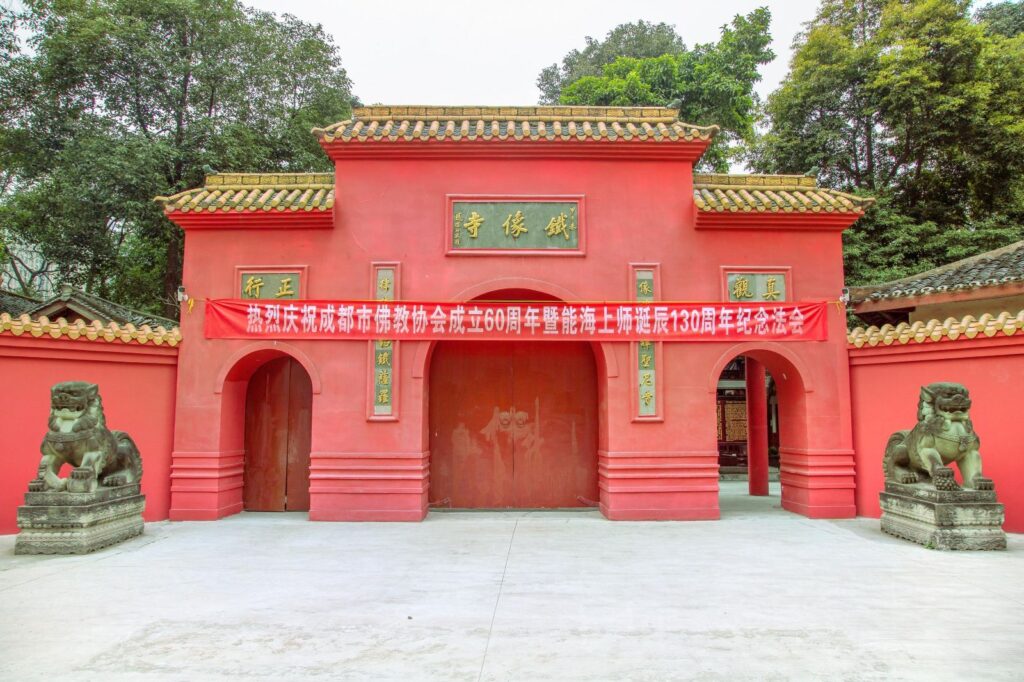
Tie Xiang Temple is located in the southern suburbs of Chengdu’s High-Tech Zone. In the 18th year of the Ming Dynasty Wanli era (1590 AD), an iron-cast statue of Sakyamuni Buddha was discovered during excavation, leading to the construction of the temple in its honor, hence the name Tie Xiang Temple. The temple underwent several renovations in the sixth year of the Tianqi era (1626 AD) and the fourth year of the Qianlong era (1739 AD). In the 1940s, the patriotic monk Neng Hai established it as one of the seven Vajra Dharma fields in the Han region for nuns after studying in Tibet. The plaque at the temple’s gate was inscribed by Zhao Puchu, the president of the Chinese Buddhist Association.
The temple complex boasts majestic halls, lush vegetation, orderly buildings, and an atmosphere of freshness, elegance, tranquility, and peace. The architecture is both independent and integrated. Upon entering the gate, one can see the magnificent Guanyin Hall, which houses a golden catalpa wood statue of the compassionate and dignified Avalokitesvara Bodhisattva, revered by all beings in the vast world for its salvation.
The second hall, the Mahavira Hall, is a Ming Dynasty structure that has preserved intricate window designs. After the wars at the end of the Ming Dynasty, few temples from that era remain in Chengdu, making this one a rare survivor. The main Buddha in the hall is the iron-cast Sakyamuni, flanked by Manjushri Bodhisattva on the left, holding scriptures and a wisdom sword, and Maitreya Bodhisattva on the right, holding a treasure vase and a Dharma wheel.
In Tibetan Buddhism, Manjushri is considered the head of the profound view (emptiness) tradition, and Maitreya is the head of the extensive practice (existence) tradition, both assisting Sakyamuni and known as the two great chariots, representing Sakyamuni’s teachings for a generation. This type of statue layout is also unique to Han region temples.
Behind the Mahavira Hall is the Sutra Pavilion, with a glazed tile roof and a ridge featuring a Dharma wheel and deer, emulating Tibetan architectural styles. Subsequently, other structures such as the Great Awakening Hall, the Universal Tower, and the Guanyin Pavilion were gradually built. The temple is open year-round from 09:00 to 17:30, with specific business hours subject to the day’s opening status.