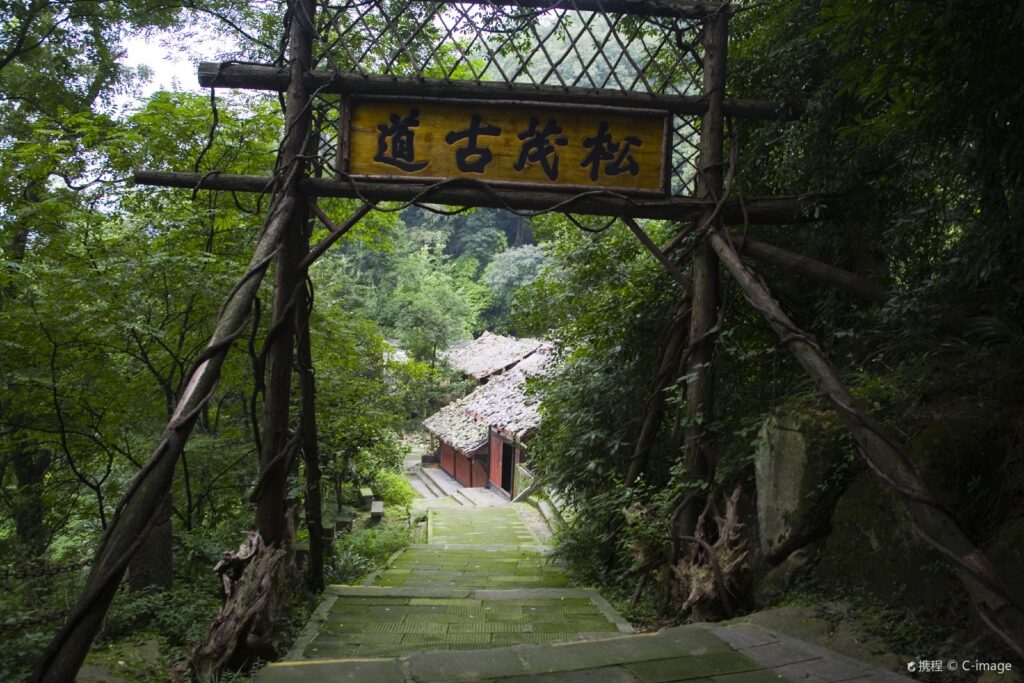
The Songmao Ancient Road begins in the west of Dujiangyan City and ends in Songpan, spanning a total length of 320 kilometers. It served as an essential transportation artery for the exchange of goods between the Chengdu Plain and the northwestern plateau of Sichuan in ancient times.
As a major economic artery in western China, the Songmao Ancient Road was also a primary channel for cultural exchange. It played a significant role in China’s history and is acclaimed as the ‘Southern Silk Road’. If extended further, this ancient path communicated with the Tubo region, reaching Nepal and India, known as the famous ‘Musky Road’.
Within the city boundaries, remnants of the ancient road can still be seen, starting from Chenghuang Slope, passing through West Gate and Yule Pass, to Erwang Temple, spanning approximately 1500 meters. The Songmao Ancient Road, historically known as ‘Ranmalongshandao’, was opened by Li Bing, the governor of Shu County in the Qin state. From 276 BC to 251 BC, Li Bing led the people of Western Shu in constructing the Dujiangyan irrigation system, greatly aided by the Jiandi people, thus opening the mountain path from Longxi to Niangziling, which later generations referred to as the ‘Songmao Ancient Road’.
On one side of the riverbank, there are stone piles and iron chains serving as railings. This ancient road, nestled against the mountains and waters, boasts enchanting and diverse scenery along its path, with a continuous flow of horse caravans and merchants. At the end of the Qing Dynasty, a local named Dong Xiangqin was invited to Songpan as a guest of Xia Zhen Tai. He recorded his observations along the Songmao Ancient Road in ‘Songyou Xiaochang’, which became widely circulated among the people.
The Songmao Ancient Road has played a tremendous role in facilitating economic and cultural exchanges among various ethnic groups throughout its long history. It is open all year round, with full-day access.