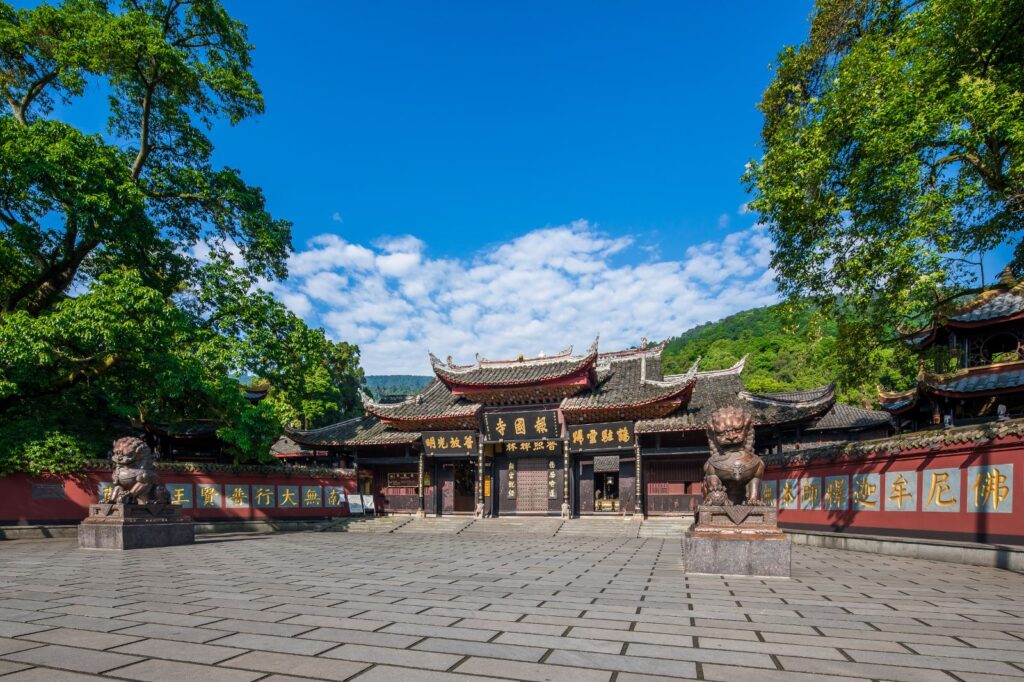
Baoguo Temple, located not far from the entrance to Emei Mountain, was originally built during the Ming Dynasty in the Wanli era. It serves as the starting point for visitors to Emei Mountain Scenic Area. The temple’s gate, adorned with a plaque inscribed with ‘Baoguo Temple’, is a calligraphy piece by Emperor Kangxi of the Qing Dynasty. It is also the central hub for Buddhist activities in the mountain. Originally named Huizong Hall, it was renamed during the Kangxi period of the Qing Dynasty.
The main halls include the Maitreya Hall, Mahavira Hall, Seven Buddhas Hall, and Samantabhadra Hall, all of which are constructed along the mountain slope, with each hall positioned higher than the previous one. Today, it is the site of the Emei Mountain Buddhist Association, where many large-scale Dharma assemblies are held.
Upon entering the gate, the first hall is the Maitreya Hall, which houses a statue of Maitreya. The second hall is the Mahavira Hall, where a gilded and colorfully adorned statue of Sakyamuni sitting on a lotus is enshrined. Ascending the stone steps leads to the Seven Buddhas Hall, which contains seven Buddha statues. Below the hall stands a fourteen-story high bronze Avatamsaka Stupa, cast during the Ming Dynasty’s Wanli era. The stupa is adorned with 4,700 small Buddhas and inscriptions of the Avatamsaka Sutra. The final hall is the Samantabhadra Hall, which enshrines the Bodhisattva Samantabhadra. Since Emei Mountain is the sacred site of Samantabhadra, he is honored in the last hall.
Opening hours: 07:00-18:00 from May 1st to September 30th; 07:30-18:00 from October 1st to April 30th.
Preferential policies: Children aged 6 and under or with a height of 1.2 meters and under enter for free. Disabled individuals with valid identification enter for free. Religious personnel enter for free on the first and fifteenth day of each month with a certificate of conversion.